


 Reuters
A devastating fire has devastated several skyscrapers in Hong Kong, killing at least 36 people. More than 270 people have been reported missing and thousands of residents are in evacuation shelters.
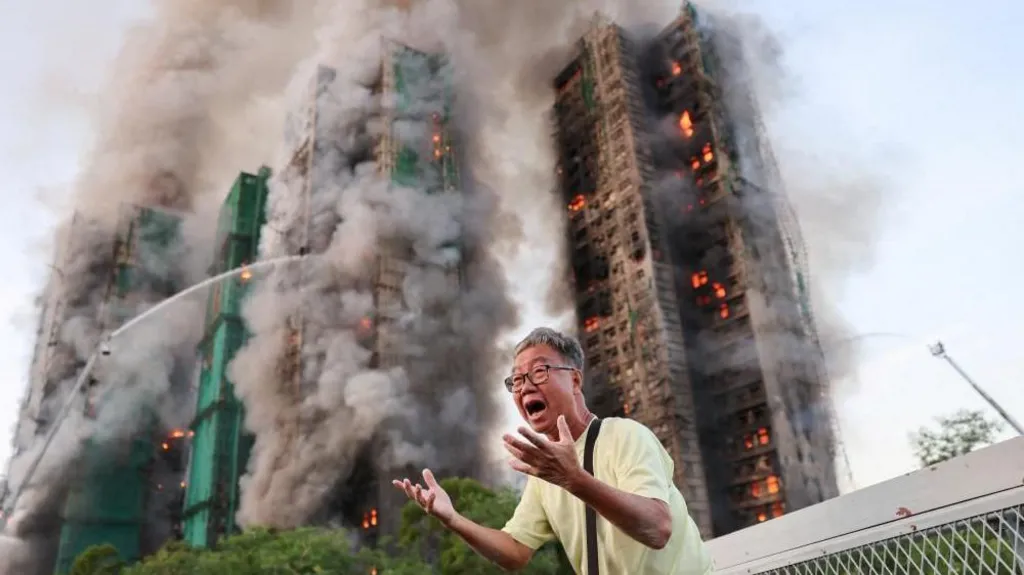
The images show several buildings on fire and thick smoke rising into the air, dominating the horizon of the Chinese territory.
As night fell, the fire was still burning hours after it was first reported, with more than 760 firefighters deployed to the scene.
Chinese President Xi Jinping expressed his condolences to the victims, including a “firefighter who died in the line of duty,” state media reports.
It’s still unclear what caused the fire, but here’s what we know so far.
Where and when did the fire start?
The fire broke out in Wang Fuk Court, a large housing complex in Hong Kong’s Tai Po district, at 2:51 p.m. local time on Wednesday (06:51 GMT).
Wang Fuk Court consists of eight towers, each 31 stories high. Seven people have been affected by the fire, Tai Po district councilor Mui Siu-fung told BBC China.
They provide 1,984 apartments for about 4,600 residents, according to the 2021 government census.
Built in 1983, the tower blocks were being renovated and the exterior of the buildings was covered with bamboo scaffolding and construction nets. The images show how the fire spreads quickly through the bamboo.
There have been reports from residents in some local media that fire alarms did not go off.
A preliminary investigation found the rapid spread of the fire was unusual, Hong Kong’s security secretary said early Thursday morning. One of the contributing factors to this was the use of polystyrene around the windows, which can be highly flammable.
Tai Po is a residential district in the northern part of Hong Kong, near the city of Shenzhen in mainland China.


How serious is the fire?
Hong Kong’s fire department has classified the fire as a level five alarm, the highest in severity.
Within 40 minutes of being first informed, it was declared level four, but at 6:22 p.m., approximately three and a half hours later, the level was raised again.
It has been 17 years since a level five fire last hit Hong Kong.
Local media reported that explosions could be heard inside the building and that fire hoses could not easily reach the highest levels.
The ferocity of the heat prevented firefighters from entering buildings to carry out rescue operations, deputy director of fire services Derek Armstrong Chan told media.
“Debris and scaffolding from the affected building are falling, posing an additional danger to our frontline staff,” he said.
It was difficult, he added, to know when the fire would be completely extinguished.
In addition to 767 firefighters, 128 fire trucks, 57 ambulances and about 400 police officers were deployed.
What do we know about the victims?
The death toll increased significantly early Thursday, from 13 to 36 people.
Shortly after midnight, Hong Kong Chief Executive John Lee confirmed that 279 people were missing.
Police officers have been helping residents search for their relatives using a loudspeaker, local media reported.
At Wednesday night’s press conference, the number of injured was revised to 15, when it had initially been estimated at 28.
Among the dead was firefighter Ho Wai-ho, 37, who served at the Sha Tin fire station for nine years.
Firefighters say they lost contact with him at 3:30 p.m. and about half an hour later discovered he had collapsed. He was taken to hospital but pronounced dead shortly afterwards.
“I am deeply saddened by the loss of this dedicated and brave firefighter,” said Andy Yeung, director of the fire service.
At least one other firefighter is in hospital, the Hong Kong fire service said.
Emergency hotline and shelters established
Several emergency shelters have been established to house residents who were evacuated, the government said. The South China Morning Post reported that one of them, the sports center on Tung Cheong Street, was full and that residents were being directed to other shelters.
Another, Kwong Fuk Community Hall, which is directly opposite the development, was deemed unsafe. The evacuees were transferred to another shelter, further away.
BBC Chinese reporter Gemini Cheng saw elderly residents, some using canes or wheelchairs, arrive at some of the shelters. Afterwards, buses will take them to community halls that will remain open overnight to accommodate those displaced by the fire.
Six schools in Tai Po will remain closed on Thursday, the Education Bureau announced, listing the affected schools on its website.
An emergency monitoring and support center is operational to manage the impact of the fire, Security Secretary Tang Ping-keung said in a statement.
Hong Kong police have set up a hotline for the public to inquire about the victims: the number is +852 1878 999.
Hong Kong and bamboo scaffolding
 Reuters
The tower blocks of Wang Fuk Court are covered with bamboo scaffolding and green construction nets, right up to the roofs, because they are undergoing renovation.
This type of scaffolding has been used in Hong Kong for centuries, as bamboo grows quickly, is lightweight and very strong. Many see it as an iconic part of the city’s urban landscape, but Hong Kong is one of the last cities in the world to use it in modern construction.
Local media reports in March said the government development office had been trying to phase out the use of bamboo over safety concerns. The push toward using metal instead of bamboo came after a series of scaffold-related deaths in Hong Kong.
Bamboo scaffolds have “intrinsic weaknesses such as variation in mechanical properties, deterioration over time and high combustibility, etc., leading to safety concerns,” said bureau spokesman Terence Lam.
The cause of this fire is still unclear, however authorities point out that it appears to have spread quickly – and to neighboring buildings – through the bamboo scaffolding.
Additional reporting by Jack Lau, BBC Global China Unit and Gemini Cheng, BBC Chinese in Hong Kong.


